I once wanted to be a pharaoh.
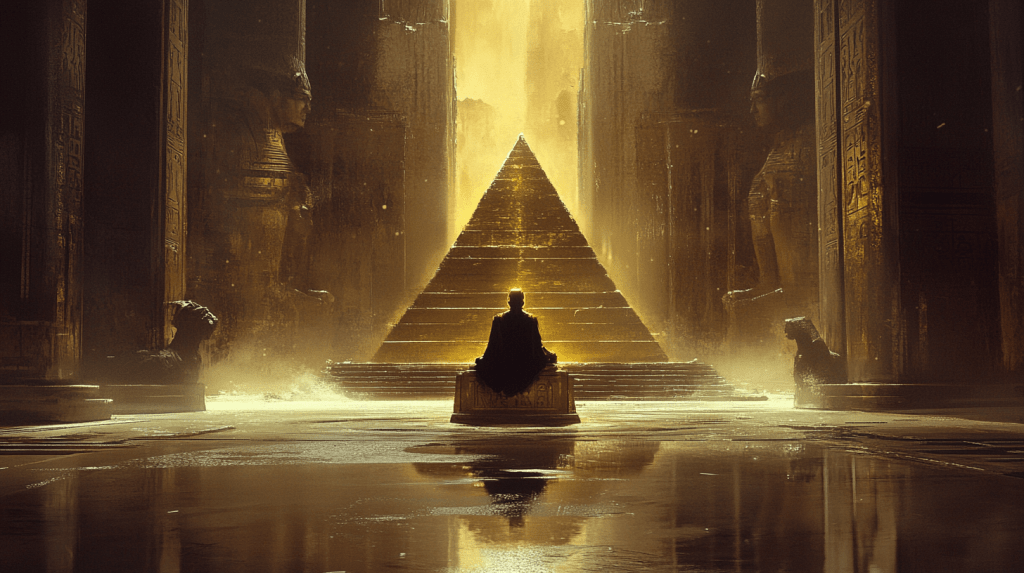
Unfortunately, even a pharaoh I created in my imagination is not immune to shadows.
He ascended too early, unprepared for the throne. He had yet to build his empire, yet to raise his pyramid, yet to carve his name into eternity. Still, he tried to make people believe that he was not like any other pharaoh before him.
In his quest for acceptance, he became the person who knew everything. He spoke as if wisdom was his birthright, as if history bent itself to accommodate his words. He crafted grand visions, erected temples in his mind, built obelisks out of borrowed philosophies and half-remembered wisdom. He believed himself untouchable, anointed by destiny.
But the echoes came, unrelenting, crashing down like a tidal wave against brittle stone, tearing through the fragile grandeur he had so carefully built.
He had expected reverence, but instead, he was met with doubt. He thought his words would command respect, yet they were dismissed as noise. The grandeur he imagined was crumbling like an unfinished tomb, weighed down by his own insecurities.
“A delusional fool who mistakes his own voice for prophecy, believing his whispers shape the world.”
“A fragile fraud, a self-crowned king of nothing, crumbling under the weight of his own arrogance.”
“A desperate impostor, clawing for recognition, yet gasping for breath beneath the tide of his own deception.”
“A jester in regal robes, parading through a court of ghosts, dancing for an audience that never existed.”
“He kneels before his own delusion, praying to a god that does not exist.”
He heard them, the whispers, the scornful laughter, the dismissive sighs. Every time he tried to stand taller, they dragged him down with disbelief. They questioned his voice, doubted his worth, dismissed his presence as fleeting.
It was unbearable.
Until he realized that it was all him.
The voices that mocked him, that discounted him, that rejected him, they were his own. He was the doubter. He was the cynic. He was the one who feared that his voice was not enough, that his presence was unworthy. He had been at war with himself all along.
The plateau was not external; it was a desert of his own making. He had prostrated not to his imagination, but to his own fear. He had built a throne, but instead of ruling, he found himself entombed within it.
And so, he sat in silence, listening not to the echoes, but to the truth beneath them. Self-acceptance, humility, and the realization that his worth was never tied to a throne, but to his own understanding of himself.
If he was both pharaoh and opposition, then perhaps, just perhaps, he could choose which one to become.

 Justian Prinz
Leave a comment